
Best In Season with Nicholas Balfe

Beef Cheeks with Smoked Beetroot & Horseradish
It’s mid-January as I type. The days are short, the sky has weight, the ground is sodden, and the nights carry a chill that calls for a roaring fire and a cosy blanket. What we ask of food shifts accordingly. This is the time for dishes that feel restorative and grounded, rooted in good produce and sound technique rather than novelty or invention. Food that nourishes properly, but still carries enough energy to enliven rather than weigh down unnecessarily.
This dish sits squarely in that space. Somerset beef cheeks from local Longhorn cattle, cooked slowly until yielding, paired with beetroot and horseradish, a combination that feels almost archetypal. There is a quiet confidence to it. In spirit, it nods to one of my favourite restaurants and enduring reference points, St John. Stripped-back cooking, rigorous seasoning, and deep respect for ingredients doing what they do best.
Why Beef Cheeks, Why Now?
Beef cheeks excel in winter. They are hardworking muscles, rich in connective tissue, that transform under slow heat into something glossy, gelatinous, and deeply satisfying.
While they have become more expensive in recent years, they still make sense both economically and gastronomically. A secondary cut with cult status, they are full of potential, capable of delivering enormous depth of flavour alongside a distinctive, melt-in-the-mouth texture. The warmer months are for quick cooks, pan-sears, and grills. Right now, I am craving slow braises, sticky, unctuous, and full of lip-smacking, restorative goodness.
Beetroot, With Added Depth
I spent a good chunk of my adult life not liking beetroot. It featured on a Christmas menu during my first Head Chef role, at Brunswick House, circa 2011, and I think after prepping vast quantities and staining countless white T-shirts, I never wanted to see another one of those purple bulbs again.
I avoided it for years before finally giving it another go and being bowled over by its depth, sweetness, and complexity. Beetroot is a familiar partner to beef, of course, but familiarity need not mean predictability. Here, the beetroot is braised and then lightly smoked over oak chips. The smoke is restrained, savoury rather than dominant, adding umami without overwhelming the beetroot’s natural sweetness.
That single layer shifts the balance of the dish, pushing it away from comfort alone and into something more considered. The technique is achievable in any kitchen, using a perforated gastro with a well-fitting lid. It also works beautifully on a covered barbecue, or better still, a small smoker if you have one to hand.
Horseradish in Balance
Horseradish brings heat, but not aggression. Mixed with crème fraîche, Dijon mustard, and lemon juice, it becomes lactic and gently sharp rather than fiery. The warmth is nostalgic but controlled, enough to cut cleanly through the richness of the beef and lift the plate as a whole.
How It Eats
The beef is unctuous and sticky, deeply savoury, the result of long cooking and careful reduction of the braising liquor. There is real gelatin here, but it never feels heavy. We are looking for a sauce that is glossy and rich yet light-footed, no Marmite intensity.
The beetroot brings earthiness and sweetness, balanced by acidity and a faint pickliness from the braise. A purée adds brightness and a touch of spice. Taken together, the dish is rich but nimble, comforting without being cloying.
A January Plate
This is not a showpiece dish, but it is quietly confident and self-assured. It can be elevated through considered plating for more formal occasions, or tumbled together as a generous, rustic sharing dish. The protein works particularly well for functions and banquets. It reheats beautifully, can be glazed and held without spoiling, and improves with time.
The garnish is robust and full-bodied, meaning it can be prepped, cooked, and set in large batches. I would serve it with crunchy potatoes, pommes Anna if capacity allows, or crisp roasted Pink Firs, as we do here at Holm, alongside winter greens or something fresher for contrast. And perhaps a glass of Loire Cabernet Franc, fine tannins, gentle spice, and enough lift to carry the dish.
It is a plate of food that feels exactly right for January: confident, nourishing, economical, and rooted in sensible, seasonal cooking. Sometimes, that is more than enough.
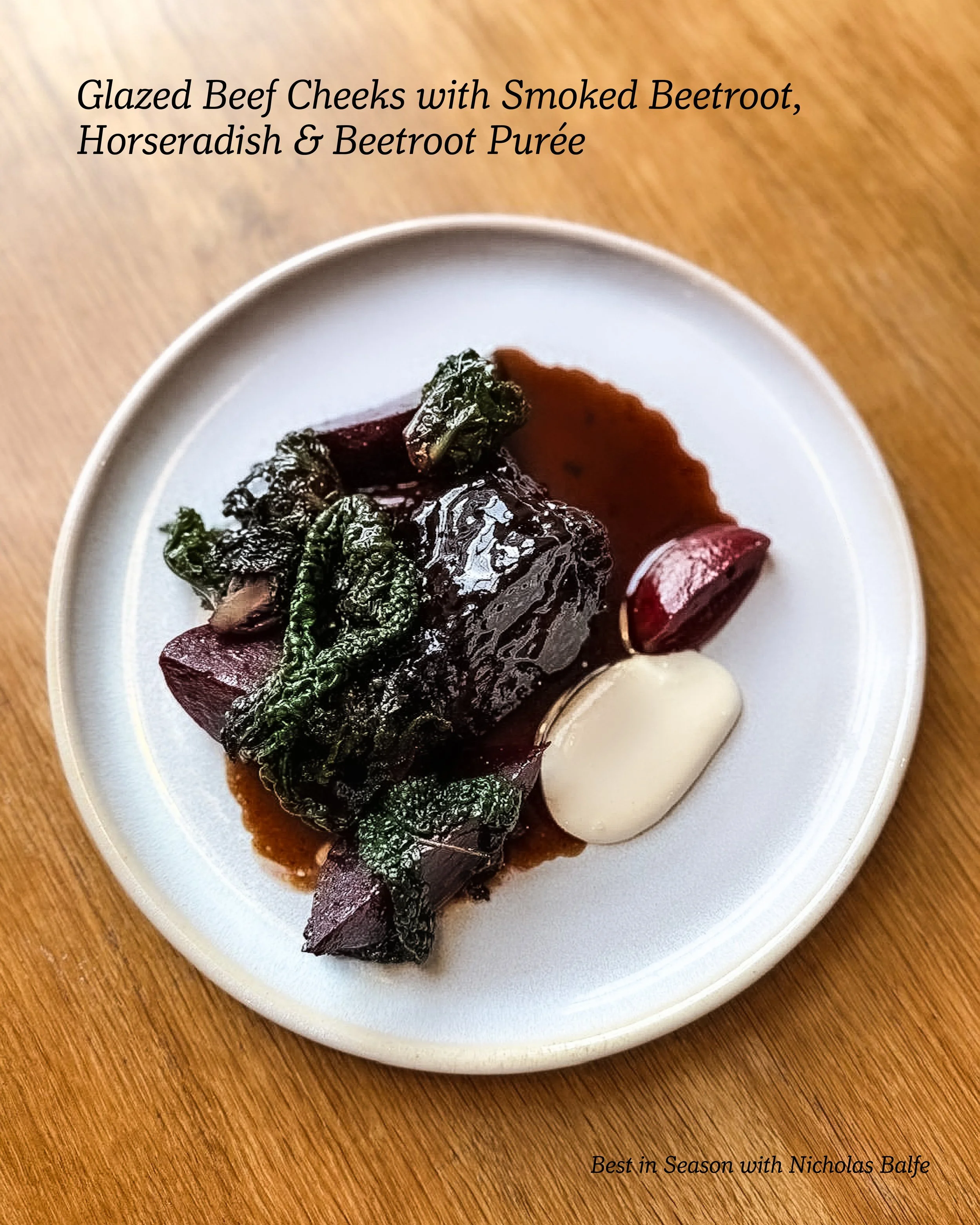
Glazed Beef Cheeks with Smoked Beetroot, Horseradish & Beetroot Purée
Beef Cheeks
Ingredients
5kg beef cheeks, untrimmed
750g brown onions, large dice
500g carrots, large dice
500g celery, large dice
2 bulbs garlic, halved
120g tomato purée
500ml red wine
2 litres beef stock, reduced by 50%
4 bay leaves
6 sprigs thyme
15g black peppercorns
Vegetable oil, as needed
Fine sea salt, as needed
Method
Trim excess sinew and silver skin from the beef cheeks. Season generously with fine sea salt.
Heat a heavy pan with a thin layer of vegetable oil and sear the cheeks well on all sides until deeply coloured, working in batches. Remove and set aside.
In the same pan, sweat the onions, carrots, celery and garlic until lightly caramelised. Add the tomato purée and cook out for 3–4 minutes.
Deglaze with the red wine, scraping the base thoroughly, and reduce by half. Return the cheeks to the pan, add the beef stock to fully cover, then add the bay leaves, thyme and peppercorns.
Bring to a gentle simmer, cover tightly and braise at 150°C for approximately 4 hours, or overnight at 95°C, until completely tender.
Cool the cheeks in the liquor. Once cold, remove the cheeks and strain the braising liquor.
Reduce the liquor until glossy and richly flavoured. Adjust seasoning.
Portion the cheeks into 10 × 250g portions. Chill the cheeks and reduced liquor separately.
Smoked Beetroot
Ingredients
3kg raw beetroot, whole
2 star anise
12 juniper berries, lightly crushed
15g black peppercorns
3 bay leaves
1 bulb garlic, halved
200ml malt vinegar
Fine sea salt, as needed
Oak chips, for smoking
Method
Place the whole beetroot into a large pan with the aromatics, garlic, malt vinegar and salt. Cover with cold water.
Bring to a simmer and cook until just tender, approximately 30–45 minutes, depending on size.
Drain and peel with your fingers while warm (wear gloves).
Cut into large wedges and chill.
For smoking: line a deep gastronorm with foil and place a small tray or foil parcel of smouldering oak chips at the base. Set a perforated gastronorm above containing the beetroot.
Cover tightly with foil or a lid and cold-smoke for 30 minutes. Alternatively, use a desktop smoker or smoking gun. Chill until required.
Beetroot Purée
Ingredients
2kg cooked beetroot, roughly chopped
300g shallots, sliced
60ml vegetable oil
80g muscovado sugar
120ml sherry vinegar
5g mixed spice
6 juniper berries, crushed
1 blade mace
1 star anise
Fine sea salt, as needed
Method
Place the shallots, oil, spices, juniper, mace and anise into a pan and cook gently until the shallots are completely soft and aromatic.
Add the beetroot and cook for a further 10 minutes.
Stir in the muscovado sugar and sherry vinegar and reduce slightly until a balanced sweet-sharp profile is achieved.
Blend until silky smooth, ideally in a Vitamix blender. Pass if desired.
Adjust seasoning and acidity. Hold warm for service or chill and reheat gently.
Horseradish Cream
Ingredients
500g crème fraîche
100g fresh horseradish, finely grated
60g Dijon mustard
50ml lemon juice
Fine sea salt, as needed
Method
Combine all ingredients thoroughly.
Season to taste, ensuring the heat remains balanced and lactic rather than aggressive.
Set aside to firm up for at least 1 hour, then keep chilled so the sauce retains its body.
Greens
Ingredients
1.5kg kale, cavolo nero or beet tops, washed
100g unsalted butter
Sherry vinegar, to finish
Fine sea salt, as needed
Freshly ground black pepper, as needed
Method
Blanch the greens in well-salted water until just tender.
Refresh in ice water, drain thoroughly and set aside until required.
Service & Finishing
Heat a heavy pan and sear the chilled beef cheeks on all sides until a deep caramelised crust forms.
Add the butter and baste until nutty and foaming.
Add the reduced braising liquor and continue basting frequently to create a glossy exterior.
If the butter and liquor begin to split, add a small dash of warm water and continue basting.
Warm the smoked beetroot gently in a butter emulsion, seasoning with salt, black pepper and a little sherry vinegar. Add the pre-steamed greens à la minute.
Keep the beetroot purée hot in a bain-marie or on the back of the stove.
Keep the horseradish cream chilled until service.
Plating
Start with two spoonfuls of beetroot purée: one in the centre to act as a base for the dish, the other to the side as a condiment for the meat.
Place the glazed beef cheek in the centre, with the smoked beetroot and greens arranged to one side, slightly obscuring the meat.
Add a spoonful of horseradish cream next to the beetroot purée condiment.
Finish with a few spoonfuls of the glazing reduction to complete the dish.
#eatwell #havefun #promisesdelivered